As winter fast approaches, images of sunny days with toes in the sand, gin-clear waters and blue skies above are no doubt popping into the heads of Covid-weary clients with far more frequency as they toil away in their cramped, makeshift home offices.
Several Caribbean destinations are offering a remedy. Their remote-work plans tout features like strong internet connectivity and offer stays of up to a year or more.
Each island offering a program has its own requirements in addition to the local Covid entry regulations. Applicants usually have to apply for the programs, be approved, provide proof of steady income, health insurance and recent negative Covid test results.
Caribbean islands have put protocols in place for travelers. Our map and report provides details on each country's entry requirements for U.S. visitors.
Here's a sampling of several of the programs offered by resorts and destinations:
Anguilla
The Working From Home in Anguilla plan gives digital nomads a choice of three categories of stay. There are fees for each, on top of charges for accommodations, meals and activities.
The fees cover costs associated with security, Covid testing, extended immigration time and digital work permits.
Visits of up to a year are available; for a full list of fees, go to ivisitanguilla.com/escape/workfromanguilla.
More than 65 approved properties -- hotels, resorts, Airbnbs and villas -- offer the work-in-Anguilla options, including two villas at Altamer Resort as well as at Zemi Beach House, which reopens on Dec. 19.
Aruba
The One Happy Workation program, launched in September, features a number of work-play packages.
Work-remote travelers must work for a company or be self-employed in their home country and are not allowed to render services to or receive income from an Aruban company without a separate work permit.

Pedja Terzin, left, and Nevena Budakov are e-commerce entrepreneurs from Los Angeles spending a month on Aruba. They say they may extend that stay.
Nevena Budakov and Pedja Terzin from Los Angeles are e-commerce entrepreneurs who are spending a month in Aruba on the Workation program, "although we're thinking of extending. It would be amazing to spend Christmas and New Year's Eve in Aruba," Terzin said.
The couple had visited the island in 2017 "and we instantly fell in love with it," said Budakov.
They are staying in one of the residences in the Aurum Collection's portfolio of townhome, villa and condominium units on Aruba's Gold Coast near Eagle Beach.
"Our business is 100% online, which gives us great flexibility," Terzin said, adding that they work with designs and large art files and "WiFi speed is crucial, and here it's been perfect."
The program allowed them "to experience the Caribbean lifestyle, get to know the Aruban people, explore the island and spend time at some of the most beautiful beaches in the world," according to Terzin.
All U.S. nationals with a valid passport are eligible to participate in the program, which has no application fee or visa fees but requires a one-time, $30 visitor insurance fee.
Applicants must work for an employer in the U.S., do not need to pay taxes in Aruba and must follow all entry requirements, which can be found at aruba.com/us/traveler-health-requirements.
There is no cutoff date for the program at this time.
Bahamas
The Bahamas Extended Access Travel Stay (Beats) initiative enables professionals and students to work and study remotely on one of 16 islands for up to a year.
"The program has been a welcome addition to our tourism offerings," said Joy Jibrilu, director general of the Bahamas Ministry of Tourism & Aviation. "The one-year residency permit has given participants the chance to enjoy our beaches while discovering the culture of the Bahamas in ways they've not before experienced."
The cost for individual professionals to obtain a permit is $1,025; for college students, the fee is $525. Accommodations, food and activities are extra.
Visitors must follow Covid-19 entry protocols and updates, which can be found at bahamas.com/tourism-reopening.
The Ocean Club, a Four Seasons Resort on Paradise Island, one of the resorts participating in the Beats program, is offering a Home by the Ocean Club.
"The experience we've designed has everything from fitness classes to keep guests active to spa treatments and laundry services," said Viktoria Riley, director of marketing. "For those traveling with children doing e-learning, we have services to oversee classes and tutors available to help with lessons and school schedules."
For more on the plan, go to fourseasons.com/oceanclub/accommodations/extended-stays/.
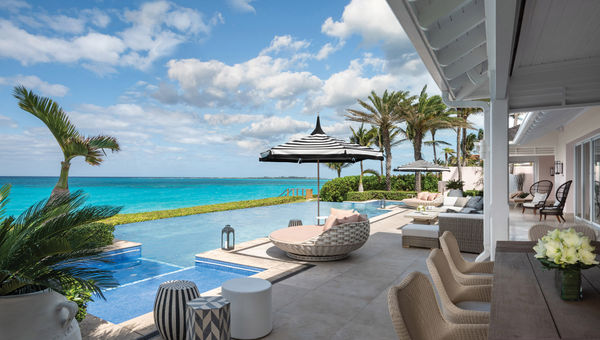
A villa terrace at the Ocean Club, a Four Seasons Resort on Paradise Island in Nassau. It has a Home by the Ocean plan for extended stays. Photo Credit: Peter Vitale
Barbados
Barbados launched its Welcome Stamp staycation plan in July, offering remote workers a chance to relocate for up to a year.
To date, the program has received 1,936 applicants of whom 743 are from the U.S.
"The program has generated a lot of interest and applicants," said Lisa Cummins, minister of tourism and international transport.
Application and fee requirements can be found at barbadoswelcomestamp.bb.
Bermuda
The One Year Work from Bermuda Certificate enables non-Bermudians to relocate to the island for research, study or work. Currently, 93 people are living on the island as part of the program.
Information is at forms.gov.bm/work-from-bermuda.
Other islands offering remote-work-and-stay programs include Antigua and Barbuda. The Cayman Islands, although it has not yet reopened to leisure U.S. travelers, has received more than 35 viable applications to date; one family has been approved and is in the Caymans.
Although Jamaica does not offer a destinationwide extended-stay program, several resorts are offering their own programs, including Jamaica Pegasus, Moon Palace, Half Moon, Hyatt Ziva and Hyatt Zilara and the Royalton Negril.
Several Marriott properties in San Juan offer an extended-stay package as does the Beach Enclave Turks & Caicos.